5GC Overview and SBA — Service-Based Architecture¶
Learning objectives¶
After reading this page, you will be able to:
- Explain what the 5GC (5G Core Network) was designed to achieve, and the design philosophy behind it.
- Explain what SBA (Service-Based Architecture) is, and the idea of NFs invoking one another as services.
- Explain that NFs communicate through SBI (Service-Based Interface), and that under the hood this is HTTP/2 + JSON.
- Intuitively explain how NRF (Network Repository Function) acts as "the NF phone book," handling registration and discovery.
- Contrast the shift in thinking from EPC → 5GC (splitting up the MME's functions, moving from dedicated interfaces to a service-based model, and thoroughly separating the Control Plane and User Plane).
- Take a bird's-eye view of 5G's three major use cases — eMBB / URLLC / mMTC — and tell them apart.
Prerequisites¶
It will go more smoothly if you first read Mobile network overview (through LTE) and get a rough grasp of the EPC (4G core) structure (MME, S-GW, P-GW, HSS) and the distinction between control signaling and user data.
What you'll learn in this chapter¶
- Why — why 5GC took the leap to a new design called SBA
- Basic Concept — build intuition through analogies of microservices, a restaurant kitchen's division of labor, and a phone book
- SBA and SBI — the idea of NFs invoking one another as services, and the means of communication
- Discovery via NRF — an intuition for the mechanism by which NFs find one another
- Thorough C/U separation — the meaning of separating the Control Plane and User Plane
- The NF as a unit — the idea of modularizing functions and combining them
- The three major use cases — an overview of eMBB / URLLC / mMTC
- Comparison with EPC — what changed, and how, from the 4G core
A full list of each NF's role is left to Network Function Overview and the NF Dictionary, and the details of reference points and protocols to Interface / Protocol Overview. This page is a conceptual page for grasping the big picture.
Why — why SBA became necessary¶
In the 4G core (EPC), NFs were connected by one-to-one dedicated interfaces. A dedicated line and protocol were defined for each combination — "S6a between MME and HSS," "S11 between MME and S-GW," and so on. This approach works reliably, but it has the following problems.
- Hard to extend — every time you add a new function, you must define a new dedicated interface with each relevant counterpart.
- Low flexibility — it is hard to scale out or replace just one function.
- Not suited to diverse services — 5G wants to provide ultra-high-speed communication, ultra-low latency, and massive IoT all on a single network. To optimize the network per use case, functions need to be recombined much more freely.
So 5GC steered toward a design in which core functions provide themselves to one another as services. This is SBA (Service-Based Architecture). By dividing each function into small parts (NFs) and letting them invoke one another through a common convention (the SBI, described below), 5GC aimed for a recombinable core in which addition, scaling, and replacement are easy.
Overview¶
At its core, 5GC boils down to three ideas.
- Divide functions into units called NFs — carve out "registration and mobility management," "session management," "authentication," and so on as independent NFs (Network Functions).
- NFs invoke one another as services — each NF exposes its function as a "service," and other NFs call it through the common interface SBI. Dedicated one-to-one interfaces have disappeared from the heart of the control plane.
- Find the counterpart via NRF — the location of each NF is registered in an "NF phone book" called NRF, and any NF that needs another queries it to discover the counterpart.
Furthermore, 5GC clearly separates the Control Plane that handles control from the User Plane that carries the actual data (C/U separation), and consolidates user data forwarding in the UPF.
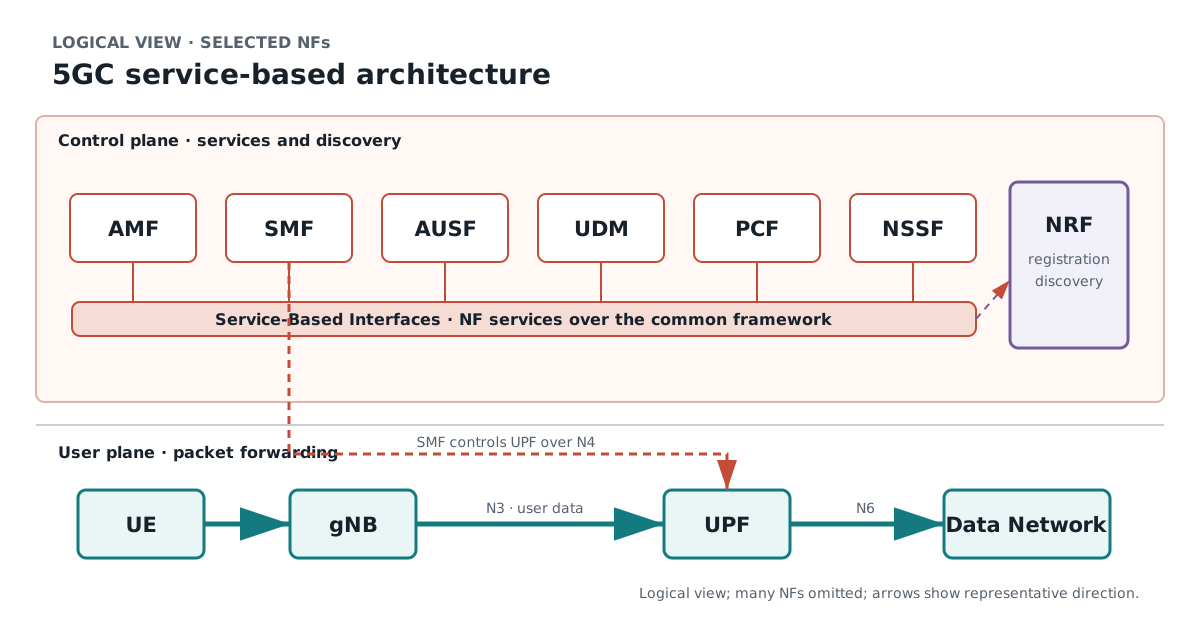
How to read the diagram: each control-plane NF (AMF/SMF/AUSF/UDM/PCF/NSSF …) connects to a common "bus" called SBI and invokes the others as services. Each NF registers with the central NRF, which serves as the point of contact for discovery. The UPF, which actually carries user data, is decoupled from the control plane, and the SMF controls it over N4 (C/U separation).
This diagram is a simplified illustration of the concept
The actual 5GC has many NFs such as NRF, NSSF, NEF, and NWDAF, and this page also omits reference points and APIs. For a full list of NFs, see the NF Dictionary; for reference points, see Interface / Protocol Overview.
Basic Concept — a beginner-friendly explanation¶
The idea of SBA can be grasped intuitively through three analogies.
1. The microservices analogy¶
The 4G EPC was closer to a large monolith in which functions were tightly coupled. The SBA of 5GC is like breaking this up into microservices. Instead of packing every function into one huge program, it is split into small independent services (NFs), each of which converses through a common convention (something like a Web API). The benefit is that you can independently scale up just one service or add a new one.
2. The restaurant kitchen division-of-labor analogy¶
The EPC's MME was like a small shop where a single chef does everything — "taking orders, cooking, and handling the bill." In 5GC the kitchen is organized by division of labor.
- The order-taker (AMF) — receiving customers (UEs) and managing their comings and goings.
- The dish-assembler (SMF) — arranging each individual dish (the data path, i.e., the PDU Session).
- The ID checker (AUSF/UDM) — verifying whether the person is who they claim to be, and whether they are a member.
With a division of labor, you can add staff only to the busy steps. Being able to reinforce only the part you need — "if reception is busy, add more reception staff" — is a strength of SBA.
3. The phone book analogy (NRF)¶
For each of the divided roles to call the others, they need to know "where is the role that does that job right now?" The internal phone book for this is the NRF. When each role clocks in, it registers in the phone book — "I can do such-and-such work" — and any role that wants to request a job looks up the phone book to discover the counterpart. This "register, look up, and find" mechanism is the foundation that keeps SBA running.
What SBA and SBI are¶
SBA (Service-Based Architecture) is the design philosophy of the 5GC control plane itself. Each NF exposes its function as a service, and other NFs invoke and use it. The key point is that "whatever the counterpart is, you can call it with the same convention," which removes dedicated one-to-one interfaces from the heart of the network.
That common convention (the calling endpoint) is the SBI (Service-Based Interface). Under the hood, the SBI is composed of the following technologies.
| Element | Content |
|---|---|
| Transport | HTTP/2 (the Web-standard protocol, excellent at multiplexing) |
| Security | TLS (encryption; HTTP/2 over TLS) |
| Data representation | JSON (human-readable structured text) |
| Design style | RESTful (resources represented by URIs, operated with GET/POST, etc.) |
In other words, the 5GC control plane has NFs conversing with one another using the same technology as web applications (HTTP/2 + JSON). The services each NF provides are given names in the form "N + NF name", such as Namf, Nsmf, and Nudm (e.g., the service provided by the AMF is Namf).
Two views: 'reference points' and 'services'
The 5GC architecture can be drawn in two ways. One is the traditional view drawn with reference points (lines connecting point to point, such as N11 and N8). The other is the service-based view (each NF connects to the SBI and calls the others by service name). These are the same network seen from different angles, and the 5GC way is to view interactions inside the control plane in service-based terms. For details, see Interface / Protocol Overview.
NF discovery via NRF¶
For NFs to freely invoke one another under SBA, there needs to be a mechanism that manages "which NF provides what service, and where (at what address) it is." The NRF (Network Repository Function) fills this role. As the 5GC's NF phone book (registry), the NRF provides the following two things.
- NF Management (registration and management) — at startup, each NF registers with the NRF: "I am such-and-such NF, I provide these services, and I am here." It updates on state changes and removes its registration when it stops.
- NF Discovery — when one NF needs another, it queries the NRF, "tell me the NFs that provide service X," and discovers candidates (addresses, etc.) that match the criteria. From the candidates obtained, it selects the one to actually call.
sequenceDiagram
    participant SMF as SMF
    participant NRF as NRF (phone book)
    participant UDM as UDM
    UDM->>NRF: (1) Register "I am UDM, I provide subscriber management"
    SMF->>NRF: (2) Discover "Which NF provides UDM?"
    NRF-->>SMF: (3) Return candidates (UDM's location)
    SMF->>UDM: (4) Call directly via SBI
How to read the diagram: the UDM registers itself with the NRF in advance ((1)), an SMF that wants to use the UDM queries the NRF ((2)) and obtains its location ((3)), and then the SMF calls the UDM directly via SBI ((4)). Not hardwiring the callee but discovering it at runtime is the source of SBA's flexibility.
For the NRF's role, APIs, and related topics, see the dedicated NRF page and the NF Dictionary.
Thorough C/U separation — separating control from user data¶
In 5GC, the network's work is divided into two planes.
- Control Plane (CP) — the command center that decides "who, where, and how communication happens." Handled by the AMF, SMF, AUSF, and others.
- User Plane (UP) — the pipe that actually carries user data (packets of web content, video, etc.). Handled by the UPF.
Through this C/U separation (thorough CUPS: Control and User Plane Separation), the command center (SMF) and the pipe (UPF) can be scaled and placed independently. For example, for latency-sensitive use cases, you can place the UPF close to the user (at the edge) to shorten the data round trip while keeping control centralized. The basic picture is that the control-plane SMF controls the user-plane UPF over N4 (for details on the UPF and N4, see the NF Dictionary and Interface / Protocol Overview).
The flow from 4G
The idea of C/U separation itself was introduced earlier in late-4G CUPS (separating control and forwarding in the S-GW/P-GW). What is different in 5GC is that it took this thoroughly, as a premise of the architecture from the very start.
The NF as a unit — modularizing functions¶
An NF (Network Function) is a part used to assemble the 5GC. Each NF has a specific role and is provided and used as a service through the SBI. Let's take a bird's-eye view of just the representative NFs (for a full list, see the NF Dictionary).
| NF | Rough role | Dedicated page |
|---|---|---|
| AMF | UE registration, connection, and mobility management (the order-taker) | AMF |
| SMF | PDU Session management and UPF control (the path arranger) | SMF |
| UPF | User data forwarding and QoS application (the pipe) | — |
| AUSF / UDM | Authentication and subscriber data management (the ID checker) | — |
| NRF | NF registration and discovery (the phone book) | NRF |
The point is that these are designed not as fixed machines but as recombinable services. Select the NFs you need for the use case, and deploy only as many as you need — this is the aim of SBA. The detailed division of roles among NFs is covered in Network Function Overview.
5G's three major use cases — eMBB / URLLC / mMTC¶
5G aimed not merely for "fast communication," but to handle three kinds of use cases with differing characteristics on a single network. This is the widely established classification of the three major use cases.
| Use case | Full name | Aim | Representative examples |
|---|---|---|---|
| eMBB | enhanced Mobile Broadband | Ultra-high-speed, high-capacity communication | High-definition video, AR/VR, large downloads |
| URLLC | Ultra-Reliable and Low-Latency Communications | Ultra-high reliability, ultra-low latency | Remote control, autonomous driving, industrial equipment control |
| mMTC | massive Machine Type Communications | Simultaneously accommodating massive numbers of devices | Large-scale IoT, sensor networks, smart meters |
These three have requirements that are, in some respects, diametrically opposed (eMBB is about bandwidth, URLLC about latency and reliability, mMTC about the number of connections). To reconcile these on a single physical network, 5GC provides mechanisms such as network slicing, which logically partitions the network by use case (slice selection is assisted by the NSSF), and edge placement of the UPF via the C/U separation described above. The flexible recombination enabled by SBA is the foundation that supports this diversity.
Comparison with EPC — what changed from the 4G core¶
Let's contrast the 4G core (EPC) with the 5GC at the turning points in thinking.
| Aspect | EPC (4G) | 5GC (5G) |
|---|---|---|
| Control-plane coupling | NFs connected by dedicated one-to-one interfaces (S6a, S11, etc.) | Invoke one another in common via SBI (HTTP/2 + JSON) |
| Function split | MME doubles as registration/mobility management and session management | Split into AMF (registration/mobility) and SMF (session management) |
| Subscriber data / authentication | Consolidated in HSS | UDM + AUSF (separated into data management and authentication server) |
| C/U separation | Introduced later as CUPS | Thorough from the start (SMF controls, UPF forwards) |
| NF discovery | Mainly static configuration | Dynamic registration and discovery via NRF |
| Extensibility | Requires adding interfaces, hard to extend | Easy to add and scale services |
The two biggest shifts are the following. First, splitting the MME's functions into the AMF (registration/mobility management) and the SMF (session management), carving up the command center by role. Second, abandoning dedicated interfaces in favor of a service-based model (SBI), turning NFs into recombinable parts. Subscriber information was also separated by role from HSS into UDM + AUSF. The overall picture of 4G/LTE is assumed from Mobile network overview.
3GPP Specification¶
The 5G system architecture is defined in TS 23.501 (System architecture for the 5G System). The definitions of SBA and SBI are in the §4 series (architecture model and concepts) of the same spec, but where there is no certainty about the exact subsection number, this text writes "TS 23.501 §4 (detailed section number to be confirmed)" and does not use plausible-looking numbers.
| Item | Reference |
|---|---|
| Overall 5G system architecture | TS 23.501 §4 (detailed section number to be confirmed) |
| The concept of SBA / service-based representation | TS 23.501 §4 (detailed section number to be confirmed) |
| Functional description of each NF (AMF/SMF/UDM, etc.) | TS 23.501 §6.2 series (organized in the NF Dictionary) |
Handling of section numbers
The section numbers for the functional descriptions of NFs (§6.2 series) are managed as confirmed values in the NF Dictionary. On the other hand, the detailed subsection numbers where the SBA/SBI concepts reside (§4 series) may differ across the release/edition referenced, so this page avoids asserting them. Fabricated numbers are not recorded.
FAQ¶
Q. What is the difference between SBA and SBI? A. SBA is the design philosophy (architecture) of "NFs invoking one another as services." SBI is the concrete calling endpoint (interface) that realizes that philosophy, and under the hood it is HTTP/2 + TLS + JSON. Remember it as: SBA is the philosophy, SBI is the means.
Q. Why use "Web technologies" like HTTP/2 and JSON in the core network? A. Because using standard technologies proven in the world of the Web makes development easier and is also advantageous in terms of performance, such as multiplexing. Rather than newly developing a dedicated protocol, placing NF services on top of established technology better fits the goal (a recombinable core) in terms of extensibility and flexibility.
Q. What happens without the NRF? A. Each NF would need to hold the counterpart's location in static configuration, undermining SBA's flexibility (runtime discovery and selection). As "the NF phone book," the NRF is the linchpin NF that makes dynamic registration and discovery possible (NRF).
Q. What does the EPC's MME correspond to in 5GC? A. There is no one-to-one correspondence. The registration and mobility management the MME handled went to the AMF, and session management went to the SMF — a split. This "function split" is a representative turning point from EPC to 5GC.
Q. Are eMBB, URLLC, and mMTC terms defined by 3GPP? A. These derive from the IMT-2020 scenarios defined by the ITU-R, and are a widely established classification of 5G's three major use cases. This page keeps to a bird's-eye view and leaves the details of realization means such as slicing to later chapters.
Summary¶
- 5GC was designed to aim for a service-based core in which functions are easy to recombine.
- SBA (Service-Based Architecture) is the design philosophy of "NFs invoking one another as services."
- Its calling endpoint is SBI, which under the hood is HTTP/2 over TLS + JSON (Web technology).
- NRF acts as "the NF phone book," handling the registration and discovery of NFs.
- C/U separation is thorough, treating control (SMF, etc.) and user data forwarding (UPF) independently.
- The shift from EPC is represented by splitting MME → AMF + SMF and turning dedicated interfaces into SBI.
- 5G aims to handle the three major use cases eMBB / URLLC / mMTC on a single network.
Practice — Comprehension check¶
Comprehension check¶
Q1. Explain the relationship between SBA and SBI in one sentence.
SBA is the design philosophy of "NFs invoking one another as services," and SBI is the concrete calling endpoint (HTTP/2 + TLS + JSON) that realizes it. They are related as philosophy (SBA) and means (SBI).
Q2. What is the NRF for? Explain with an analogy.
It is the phone book (registry) of NFs. Each NF registers its functions and location, and any NF that wants to use a counterpart queries the NRF to discover it. Not fixing the callee but finding it at runtime is the source of SBA's flexibility.
Q3. How did the EPC's MME change in 5GC?
The functions the MME had doubled up on were split into the AMF (registration/mobility management) and the SMF (session management). The important point is that this is not a one-to-one replacement.
Q4. State eMBB, URLLC, and mMTC each in one phrase.
eMBB = ultra-high-speed and high-capacity, URLLC = ultra-high reliability and ultra-low latency, mMTC = simultaneously accommodating massive numbers of devices. The aim of 5G is to handle these three use cases with differing requirements on a single network.
Next Step¶
- Network Function Overview — learn the division of roles among NFs in more detail
- Interface / Protocol Overview — learn the details of reference points, SBI, and protocols
- NF Dictionary — look up the official names, roles, and APIs of all NFs
- Registration (initial registration) — see how SBA/NFs actually cooperate in a real procedure (Level 2)