4G-5G Interworking — How UEs Move Across EPC and 5GC¶
Learning objectives¶
After reading this chapter, you will be able to:
- Explain that Interworking (4G-5G interworking) is "the mechanism that lets a UE move back and forth between 4G(EPS) and 5G(5GS)."
- Explain that the presence of N26 (AMF⇔MME) governs the Interworking method (Single-registration / Dual-registration).
- Distinguish the two ways of moving: Idle mode mobility (moving via TAU/Registration while idle) and Handover (connected mode).
- Explain the idea of the shared nodes (SMF+PGW-C, UPF+PGW-U) that underpin Interworking.
- Explain the relationship between Interworking and EPS Fallback (EPS Fallback is one application of Interworking).
Prerequisites¶
It will go more smoothly if you understand the following first.
- Handover — the connected mode transition of Interworking is an Inter-System Handover (an HO between 4G⇔5G), understood as an extension of Xn/N2 HO.
- Mobility Registration Update / 4G's TAU — the idle mode transition is done via this registration update (5G side) and TAU (4G side).
- Registration (initial registration) — understanding the state in which a UE is registered in 5GS/EPS respectively.
- QoS (the 5G QoS model) — the mapping of 5QI↔QCI and QoS Flow↔EPS bearer.
- Supplementary: AMF / SMF / N26
What you'll learn in this chapter¶
- Why — why a mechanism to move back and forth between 4G and 5G is needed
- Basic Concept — the idea of "carrying over the records of a person who travels between two countries"
- What N26 is (column) — the interface that underpins mobility across 4G/5G
- Architecture — the cast of 5GC, 4G(EPC), and shared nodes involved in Interworking
- Single-registration / Dual-registration — the two modes determined by the presence of N26
- Procedure — Idle mode and Handover — the two families of ways to move
- Relationship with EPS Fallback / mapping of identifiers and QoS / Release differences / Trouble Shooting / FAQ / Practice
Why — why a mechanism to move back and forth between 4G and 5G is needed¶
5G (5GS) does not spread all at once. The coexistence of 5G areas and 4G (LTE/EPS) areas is the reality of deployment. When a UE moves from a 5G area to a 4G area (or vice versa), communication must be handed over without being dropped.
If there were no mechanism at all, communication would break the moment the UE left the 5G area, and it would have to reconnect from scratch on 4G. Even in-progress data communication (PDU Session / PDN connection) could be lost. This is a heavy burden on both the user experience and the network.
So a mechanism is needed that links 4G(EPS) and 5G(5GS) so that a UE can keep communicating even as it crosses the boundary. This is Interworking (4G-5G interworking). It is specified in 3GPP TS 23.501 / TS 23.502 (the detailed section numbers are to be confirmed). Thanks to Interworking, users can keep communicating at the "seam between 5G and 4G" even while 5G is still being rolled out.
Overview¶
Interworking is easier to understand when organized along the following two axes.
- Presence of N26 (mode) — whether the N26 interface connecting 4G's MME and 5G's AMF exists.
- Single-registration mode (with N26) — the UE registers with only one of 4G or 5G, and state is carried over via N26 for a seamless transition (Handover possible).
- Single-registration mode (without N26) — single registration is still possible without N26, but the transition is centered on idle mode, using redirection and the like.
- Dual-registration mode (without N26) — the UE registers with both 4G and 5G simultaneously (dual registration) and switches under UE control.
- Way of moving (Procedure) — at what timing/state the move happens.
- Idle mode mobility — while the UE is idle, it moves by performing TAU (4G) / Registration (5G) in the destination.
- Handover (connected mode) — while the UE is communicating (connected), it moves seamlessly via an Inter-System Handover.
The key point is that with N26, a seamless transition via connected mode Handover becomes possible. Without N26, the transition is centered on idle mode (or dual-registration, where the UE registers with both and switches on its own).
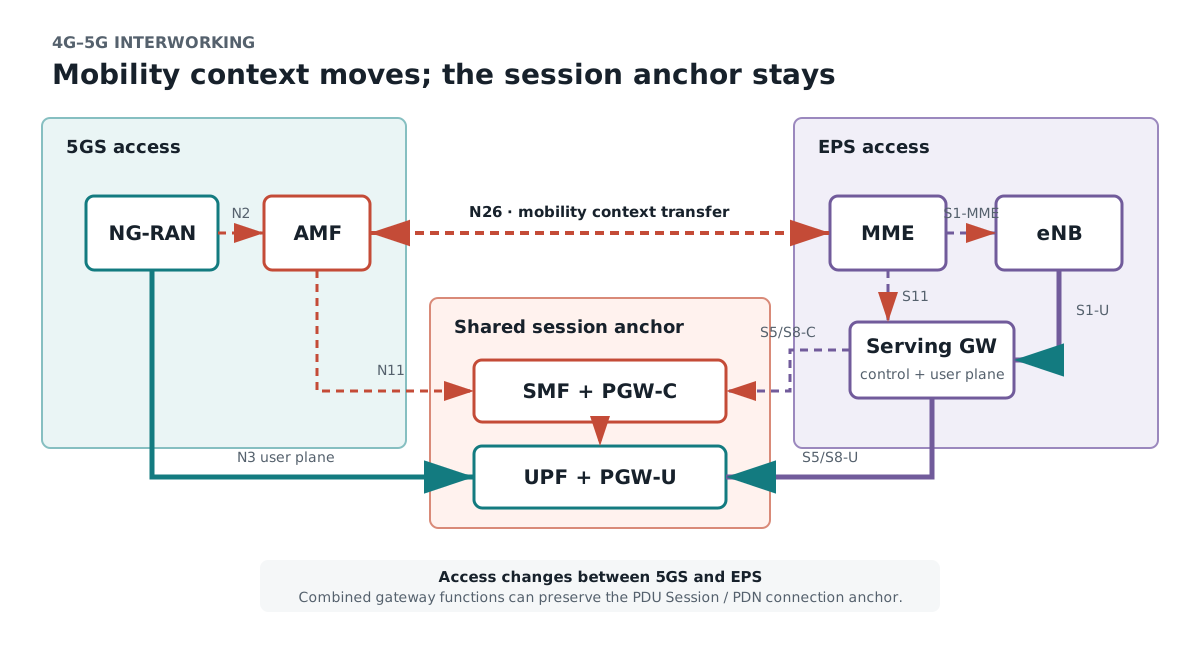
And another important element is the shared nodes that underpin Interworking. The 5G SMF doubles as the 4G PGW-C (SMF+PGW-C), and the 5G UPF doubles as the 4G PGW-U (UPF+PGW-U). Through this sharing, the same session anchor (the gateway of the PDN/PDU session) can be shared across 4G/5G, allowing the transition while keeping the IP address.
Basic Concept — a beginner-friendly explanation¶
Interworking can be likened to "carrying over the records of a person who travels between two countries (4G and 5G)."
- You (the UE) are in the country of 5G, communicating. Sometimes you leave the country of 5G and move to the country of 4G.
- Without any mechanism, your records break off at the border, and you need entry procedures (reconnection) from scratch in the country of 4G.
- So the two countries' counters (AMF and MME) are connected by a dedicated line (N26), so that your records (UE context, session information) are carried over.
- With the dedicated line (with N26) — the counters can hand records to each other, so you can move smoothly even while walking (communicating) (Handover).
- Without the dedicated line (without N26) — instant handover of records is not possible, so either you stop for a moment (go idle) and then re-register in the destination (idle mode), or you keep a resident registration in both countries and travel back and forth on your own (dual-registration).
Furthermore, the two countries' "post offices (the session anchor)" share the same building (SMF+PGW-C / UPF+PGW-U). Because you keep using the same post office, your address (IP address) does not change, and your parcels (data) keep arriving.
Column: What N26 (the AMF⇔MME interface) is
N26 is the interface connecting the 5GC's AMF and 4G/EPC's MME (Mobility Management Entity). It is used to carry over the mobility management context (the UE's state, bearer/session information, etc.) when moving a UE across 4G and 5G.
- With N26 — because state can be carried over between 4G/5G, a seamless Inter-System Handover in Single-registration mode is possible.
- Without N26 — because state cannot be carried over instantly, the transition is centered on idle mode, or uses Dual-registration mode (the UE registers with both and switches on its own).
N26 uses GTPv2-C, the same as the 4G/EPC family — which differs from the many 5G reference points that are SBI (HTTP/2). For details, see the N26 interface page.
Architecture¶
graph LR
    UE["UE"] -- "N1(NAS)" --> AMF["AMF (5GC)"]
    UE -- "Radio (NR)" --> RAN["NG-RAN"]
    UE -- "Radio (LTE)" --> ENB["eNB"]
    RAN -- "N2" --> AMF
    AMF <-- "N26" --> MME["MME (4G/EPC)"]
    ENB -- "S1-MME" --> MME
    AMF -- "N11" --> SMFC["SMF + PGW-C (shared)"]
    MME -- "S11" --> SGW["Serving GW"]
    ENB -- "S1-U" --> SGW
    SGW -- "S5/S8-C" --> SMFC
    SMFC -- "N4" --> UPFU["UPF + PGW-U (shared)"]
    RAN -- "N3" --> UPFU
    SGW -- "S5/S8-U" --> UPFU
    UPFU -- "N6/SGi" --> DN["Data Network"]
How to read the diagram: on the control plane, the AMF (5GC) and the MME (4G/EPC) are connected by N26, carrying over the mobility context between 4G/5G. On the session plane, the SMF doubles as the PGW-C (SMF+PGW-C) and the UPF doubles as the PGW-U (UPF+PGW-U), so the same session anchor is shared across 4G/5G. This lets the UE transition between 4G⇔5G while keeping its IP address. The radio switches between NG-RAN (5G) ⇔ eNB (LTE) before and after the transition. For the details of individual session control, see SMF; for the details of N26, see the N26 page (they are not repeated in this chapter).
Single-registration mode and Dual-registration mode¶
The Interworking mode is divided by the presence of N26 and how the UE holds its registration.
| Aspect | Single-registration (with N26) | Single-registration (without N26) | Dual-registration |
|---|---|---|---|
| UE registration | Only one of 4G or 5G | Only one of 4G or 5G | Simultaneous registration with 4G and 5G |
| N26 | Yes | No | No |
| State carry-over | Context transferred via N26 | No instant carry-over | UE holds both systems |
| Main transition method | Handover (connected) possible / idle mode | idle mode (redirection, etc.) | UE-driven switching |
| Seamlessness | High (Handover possible) | Relatively low | UE implementation-dependent |
| Network configuration | N26 configuration required | N26 not required | N26 not required |
Which to choose is a network design decision
Single-registration (with N26) excels at seamless transition, but requires the configuration of N26. Dual-registration does not require N26 and keeps the network simpler, but the UE must manage dual registration across 4G/5G, and the smoothness of switching depends on the UE implementation. Which to adopt is the operator's design decision (implementation-dependent), and the spec permits all of them. The precise conditions of applicability and the section numbers are to be confirmed against 3GPP TS 23.501/23.502.
Procedure — Idle mode and Handover¶
The "way of moving" in Interworking is divided into two families by the UE's state (idle or communicating).
sequenceDiagram
    participant UE
    participant RAN as NG-RAN(5G)
    participant AMF
    participant MME as MME(4G)
    participant ENB as eNB(4G/LTE)
    participant SMFC as SMF+PGW-C

    Note over UE,SMFC: (A) Idle mode mobility (moving while idle)
    UE->>ENB: Camp on LTE and do TAU(Tracking Area Update)
    ENB->>MME: Forward TAU
    opt With N26
        MME->>AMF: Request UE context over N26
        AMF-->>MME: 5GS-side context response
    end
    MME->>SMFC: Continue the session (PDN) on the 4G side
    Note over UE,ENB: Communication continues on 4G (IP retained)

    Note over UE,SMFC: (B) Handover (connected mode, with N26)
    RAN->>AMF: N2 Handover Required (→EPS)
    AMF->>MME: Transfer context over N26
    MME->>ENB: Prepare 4G-side resources
    RAN-->>UE: Inter-System Handover Command (→LTE)
    UE->>ENB: Communication continues seamlessly on LTE
Explanation of the procedure:
- (A) Idle mode mobility — the UE, while idle, camps on the destination radio (e.g. LTE) and performs TAU (4G) / Registration (5G). If there is N26, the destination node (MME/AMF) retrieves the UE context from the counterpart over N26, and continues the session (PDN/PDU session). The shared nodes (SMF+PGW-C, etc.) allow the IP address to be retained. For the details of the 5G-side registration update, see Mobility Registration Update; the 4G side is TAU.
- (B) Handover (connected mode) — while the UE is communicating, on the premise of N26 present, it moves seamlessly via an Inter-System Handover. For 5G→4G, the NG-RAN issues an N2 Handover Required, the AMF transfers the context to the MME over N26, and it transitions smoothly to LTE (the idea of Inter-System HO is an extension of the Handover chapter).
Think of 5G→4G and 4G→5G as symmetric
The diagram above mainly shows the 5G→4G direction, but the 4G→5G direction is symmetric. For 4G→5G idle mode, the UE does a 5G Registration in the destination; for connected mode, it moves to 5GS via an Inter-System Handover with N26. Even when the direction changes, the skeleton — "carry over the context via N26 and continue the session via the shared nodes" — is common.
Relationship with EPS Fallback¶
EPS Fallback is one application of this chapter's Interworking (a case specialized for voice calls).
- Interworking (this chapter) — the general mechanism for moving back and forth between 4G⇔5G (continuation of data communication, both idle/connected, bidirectional).
- EPS Fallback — of those, the specific use of "when a voice call arises in a cell that does not support VoNR, moving the UE from 5GS→4G/EPS to complete the voice call via VoLTE."
In other words, the Handover-based (with N26) / Redirect-based (without N26) transition that EPS Fallback uses is precisely the framework of this chapter's Handover / idle mode (redirection). Positioning EPS Fallback as "a kind of Interworking triggered by voice" neatly organizes the relationship between the two. The voice-specific branches of the procedure (5QI=1 request → determination of no VoNR support → VoLTE completion) are consolidated in the EPS Fallback chapter.
4G/5G mapping of identifiers and QoS¶
In Interworking, 4G and 5G identifiers and QoS are mapped to one another (for details, see each chapter / dictionary).
| 5G (5GS) | 4G (EPS) | Notes |
|---|---|---|
| 5G-GUTI | GUTI (4G-GUTI) | UE temporary identifier. A mapping exists |
| Registration Area (TAI list) | TA List (TAU) | The idea of the tracking area is common (Mobility Registration Update) |
| PDU Session | PDN connection | Continued via the shared anchor (SMF+PGW-C/UPF+PGW-U) |
| QoS Flow (5QI) | EPS bearer (QCI) | 5QI=1↔QCI=1 (conversational voice/GBR) and 5QI=5↔QCI=5 (IMS signaling/Non-GBR) are in TS 23.501 §5.7.4. Other values are to be confirmed |
| AMF | MME | The control-plane mobility management NF (coordinated via N26) |
The details of identifier mapping are to be confirmed
The concrete mapping rules and bit-structure details of 5G-GUTI↔GUTI and the like are specified in 3GPP TS 23.003 / TS 23.501 and others, but the exact section numbers and conversion rules are to be confirmed. This table is a bird's-eye view of the correspondences; for the exact conversions, refer to each spec.
Release differences¶
- Rel-15: the framework of 4G-5G Interworking (with/without N26, Single-/Dual-registration) was specified. A foundational function premised on the 4G/5G coexistence of early 5G deployment.
- Rel-16 onward: enhancements to voice continuity, mobility optimization, and the like advance, but the individual feature additions and revisions are to be confirmed against each TS (this chapter does not assert them).
Trouble Shooting¶
| Symptom | Presumed cause | What to check | Logs/Packets | Direction of remedy |
|---|---|---|---|---|
| Communication breaks on the 5G→4G transition | Handover impossible because N26 is not configured | Presence of N26 configuration | N2 Handover, N26 (GTPv2-C) | Configure N26, or check a design premised on idle mode |
| IP changes after the transition and the session drops | Session anchor not shared | SMF+PGW-C/UPF+PGW-U sharing | Session anchor configuration | Check the shared-node configuration |
| Switching is slow with Dual-registration | Depends on UE implementation / switching policy | UE dual-registration behavior | UE-side logs | UE implementation-dependent, to be confirmed |
| Registration fails on the idle mode transition | TAU/Registration inconsistency | 4G/5G registration state | TAU, Registration Request | Check registration state and identifier mapping |
| Only voice calls drop to 4G | Normal EPS Fallback | Whether the cell supports VoNR | EPS Fallback chapter | Resolved by expanding VoNR-capable cells |
3GPP Specification¶
- 3GPP TS 23.501 — 5G system architecture. Definitions of Interworking with EPC, N26, and the shared nodes (SMF+PGW-C, etc.) (detailed section numbers to be confirmed)
- 3GPP TS 23.502 — procedure specification. The procedures of Handover / idle mode mobility between 4G/5G (section numbers to be confirmed)
- 3GPP TS 23.501 §5.7.4 — the standardized 5QI table (5QI=1 conversational voice/GBR, 5QI=5 IMS signaling/Non-GBR)
- 3GPP TS 29.274 — GTPv2-C (the control-plane protocol used by N26). Individual section numbers to be confirmed
- 3GPP TS 23.003 — identifiers (mapping of 5G-GUTI/GUTI, etc.). Individual section numbers to be confirmed
FAQ¶
Q. What is Interworking, in the end? A. It is the mechanism that lets a UE move back and forth between 4G(EPS) and 5G(5GS) and keep communicating even as it crosses the boundary. The control plane is underpinned by N26 (AMF⇔MME), and the session plane by the shared nodes (SMF+PGW-C / UPF+PGW-U). It is specified in 3GPP TS 23.501/23.502.
Q. Is N26 mandatory for Interworking? A. No, it is not mandatory. With N26, a seamless Handover in Single-registration mode becomes possible, but even without N26, Interworking can be realized via an idle-mode-centered transition or via Dual-registration mode (the UE registers with both and switches on its own). It is a design decision.
Q. What is the difference between Single-registration and Dual-registration? A. The difference is whether the UE registers with only one of 4G or 5G (Single) or with both simultaneously (Dual). Single (with N26) carries over state via N26 and can Handover. Dual does not require N26 but, in exchange, the UE manages the dual registration and switches on its own.
Q. How do the Idle mode and Handover transitions differ? A. Idle mode is the method where the UE, while idle, performs TAU/Registration in the destination to move; Handover is the method where the UE, while communicating (connected), moves seamlessly via an Inter-System Handover. Handover generally requires N26.
Q. How does EPS Fallback differ from Interworking? A. EPS Fallback is one application of Interworking. Whereas Interworking is the general framework for 4G⇔5G movement, EPS Fallback is the specific use of "moving from 5GS→4G to complete the call via VoLTE only for a voice call." The transition methods (Handover/Redirect) use the Interworking framework.
Summary¶
- Interworking (4G-5G interworking) is the mechanism that lets a UE move back and forth between 4G(EPS)⇔5G(5GS) and keep communicating even as it crosses the boundary (3GPP TS 23.501/23.502).
- The presence of N26 (AMF⇔MME) governs the mode. Single-registration (with N26) allows a seamless Handover; Dual-registration (without N26) has the UE register with both and switch on its own.
- The ways of moving are the two families of Idle mode mobility (TAU/Registration) and Handover (connected mode, Inter-System HO).
- Sessions share the anchor across 4G/5G via the shared nodes (SMF+PGW-C / UPF+PGW-U), continuing while retaining the IP address.
- EPS Fallback is one application of Interworking specialized for voice calls. Identifiers map as 5QI=1↔QCI=1 and 5QI=5↔QCI=5.
Practice — Comprehension check¶
Comprehension check¶
Q1. What does the presence of N26 govern in Interworking?
It governs the mode (Single-registration / Dual-registration) and the transition method. With N26, a seamless Inter-System Handover (connected mode) with carried-over state is possible in Single-registration mode. Without N26, it becomes either an idle-mode-centered transition or Dual-registration mode, where the UE registers with both 4G/5G and switches on its own.
Q2. How do Idle mode mobility and Handover differ?
Idle mode mobility is the method where the UE, while idle, camps on the destination radio and performs TAU (4G) / Registration (5G) to move. Handover (connected mode) is the method where the UE, while communicating, moves seamlessly via an Inter-System Handover, and generally requires N26.
Q3. Why can Interworking move the UE while keeping the IP address?
Because the shared nodes — the 5G SMF doubling as the 4G PGW-C (SMF+PGW-C) and the 5G UPF doubling as the 4G PGW-U (UPF+PGW-U) — mean the same session anchor (gateway) is shared across 4G/5G. Since the anchor does not change, the transition keeps the IP address and the session.
Q4. Explain the relationship between EPS Fallback and Interworking.
EPS Fallback is one application of Interworking (a case specialized for voice calls). Whereas Interworking is the general framework for 4G⇔5G movement, EPS Fallback is the specific use of "when a voice call arises in a cell that does not support VoNR, moving the UE from 5GS→4G to complete it via VoLTE," and its transition uses the Interworking framework of Handover-based (with N26) / Redirect-based (without N26).
Next Step¶
- N26 (AMF⇔MME) — the details of the interface that underpins Interworking's control plane
- EPS Fallback — the voice-specialized application of Interworking. From the 5QI=1 request to VoLTE completion
- Handover — the foundation of the Inter-System Handover used by the connected mode transition
- Mobility Registration Update — the 5G-side registration update used by the idle mode transition (corresponding to 4G's TAU)
- QoS (the 5G QoS model) — return to and deepen the mapping of 5QI↔QCI and QoS Flow↔EPS bearer