Mobile Network Overview (up to LTE/4G)¶
Learning objectives¶
By the time you finish this chapter, you will be able to:
- Explain how mobile networks differ from fixed networks (mobility, radio, and subscriber management)
- Give a broad-brush explanation of the progression from 2G → 3G → 4G LTE
- Explain the main players of LTE/EPC (UE, eNB, MME, S-GW, P-GW, HSS) and their respective roles
- Explain why we consider the Control Plane (C-Plane) and the User Plane (U-Plane) separately
- Picture the EPS bearer as "the path that data travels from the device to the external network"
- Understand how these serve as your "map of 4G" when learning 5GC
Prerequisites¶
There are no special prerequisites. Having some exposure to basic communication-network terms such as nodes, links, addresses, and layers will help you understand faster, but this chapter is written for beginners, so you can read straight through even without prior experience.
What you'll learn in this chapter¶
- Why — why mobile networks are more complex than fixed networks
- Overview — grasp the big picture of LTE/EPC in a single view
- Basic Concept — the analogy of "delivering letters to a user who keeps moving house"
- The progression of generations — an overview of 2G / 3G / 4G LTE (without going deep)
- The players of LTE/EPC — the roles of eNB / MME / S-GW / P-GW / HSS
- Separation of C-Plane and U-Plane — why control and data are separated
- EPS bearer — the idea of a data path (lightly)
- A bridge to 5GC — in the next chapter, how 5GC reworked all this
Why — why mobile networks are special¶
With fixed-line phones or an office LAN, equipment is fixed in one place by cables. Neither the destination nor the wiring changes. In a mobile network, however, users keep communicating while moving around on foot, by train, or by car. This gives rise to three difficulties that fixed networks do not have.
- Mobility management (mobility) — the network must continuously keep track of which area a user is currently in, and whether they have moved to a different base station during a session
- Radio — the final segment is over the airwaves, and radio waves can weaken or suffer interference. The finite, precious radio resource must be shared among many users
- Subscriber management and authentication — the network must verify that "this device (user) is really the contracted subscriber," and treat each one differently according to their contract (available speed, services)
If a fixed network solves the problem of "delivering to a party that doesn't move," a mobile network solves the problem of "delivering to a party who keeps moving house, while verifying their identity, over limited radio." To solve these three points, mobile networks are equipped with dedicated nodes and rules.
Overview¶
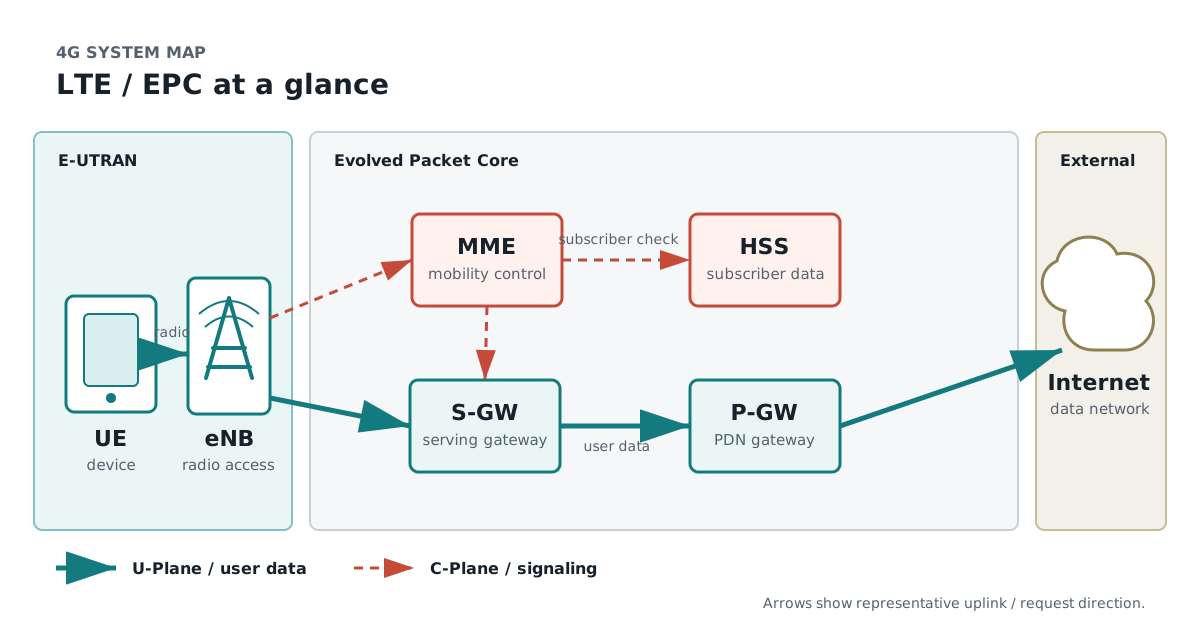
A 4G (LTE) network is broadly divided into two parts.
- Radio access network (E-UTRAN) — the part that connects to the device over radio. The base station eNB handles this
- Core network (EPC: Evolved Packet Core) — the "brains and traffic control" part beyond the eNB. It handles mobility management, authentication, and data forwarding
Within the EPC, roles are clearly divided. The nodes that handle control signaling (who is where, whether to permit communication, etc.) are separate from the nodes that carry user data (the actual content of web pages and apps). The former is called the Control Plane (C-Plane) and the latter the User Plane (U-Plane), and this separation is the backbone of the architecture from LTE onward.
There are six main players: UE (device), eNB (base station), MME (the control role for mobility management and authentication), S-GW / P-GW (the gateways that carry data), and HSS (the subscriber database). Their roles are described below.
Basic Concept — a beginner-friendly explanation¶
Delivering letters to a user who "keeps moving house"¶
Communication networks are often likened to the postal system. It helps to think of a mobile network as a mechanism that makes that postal service work in a situation where "the recipient is constantly moving house."
- The user (UE) wants to receive letters (data) while moving on a train
- Each area has a handover counter (eNB = base station), and the user deals with the nearest counter
- The MME is the manager who tracks "which counter this person is near right now"
- The S-GW / P-GW are the gateways that move the letters themselves to and from the outside world (the internet)
- The HSS is the register that records "whether this person is a legitimate subscriber, and what services they may use"
Even when a user moves from the area of counter A to the area of counter B (a handover), the manager updates their location, and the gateway reroutes the flow of data to the new counter. That is why communication continues without interruption.
Quick reference of roles¶
| The key player | Full name | Role (roughly) | Analogy |
|---|---|---|---|
| UE | User Equipment | Device (smartphone, etc.) | The user who receives the letters |
| eNB | evolved Node B | Base station (handles the radio segment) | The local handover counter |
| MME | Mobility Management Entity | Control role for mobility management and authentication | The manager who tracks locations |
| S-GW | Serving Gateway | Relay gateway for user data | The regional distribution center |
| P-GW | PDN Gateway | Exit to the external network (internet) | The gateway to the outside world |
| HSS | Home Subscriber Server | Subscriber database | The register of subscribers |
The progression of generations — an overview of 2G / 3G / 4G LTE¶
Generation by generation, mobile networks have shifted from "voice-centric" to "data-centric," and from "circuit switching" to "packet switching." Without going deep into the details, let's grasp just the broad flow.
| Generation | Main use | Switching characteristics | In a nutshell |
|---|---|---|---|
| 2G | Voice, SMS | Mainly circuit switching | The generation that made "talking on a mobile phone" real |
| 3G | Voice + data | Circuit switching and packet switching coexist | The gateway to mobile internet |
| 4G (LTE) | Data-centric (voice also packetized) | All-IP / packet switching | The generation that made "internet on a smartphone" ordinary |
The key point is that 4G (LTE) thoroughly implemented "all-IP," carrying everything — including voice — as IP packets. The core that removed the circuit-switching machinery of the traditional telephone network and unified everything on packet switching is the EPC. Voice calls are also packetized, and this is provided as VoLTE (Voice over LTE).
Distinguishing 'LTE' from 'EPC'
Strictly speaking, LTE is the name of the radio-access (E-UTRAN) technology, while EPC refers to the core network beyond it. In everyday usage, however, "LTE" often refers to the entire 4G system (radio + core), and the 4G system that combines both is called EPS (Evolved Packet System). This chapter uses these terms as the context requires.
The players of LTE/EPC and their roles¶
From here we look at each node a little more concretely. That said, we leave detailed protocol names and messages to later chapters and the dictionary, and concentrate on "what role each one plays."
eNB — base station (handles the radio segment)¶
The eNB (evolved Node B) is the base station that connects to the UE over radio. It handles scheduling of the radio segment (which device gets the limited radio resource, and when) and controls handover to a neighboring eNB. The eNB is the only node that deals with radio, and it connects to the core network (EPC) beyond it over wires.
MME — the control role for mobility management and authentication (C-Plane)¶
The MME (Mobility Management Entity) is the center of the EPC's control plane. Its main roles are as follows.
- Mobility management — keeping track of which area (tracking area) a UE is currently in, and paging a device that is on standby
- Session management control — issuing instructions to set up and release the "path (bearer)" through which a UE communicates
- Authentication control — working with the HSS to advance the procedure that verifies whether a UE is a legitimate subscriber
The important point is that the MME handles only control signaling; user data itself does not pass through it. Data goes through the S-GW / P-GW described below.
S-GW / P-GW — the gateways that carry user data (U-Plane)¶
The S-GW (Serving Gateway) and P-GW (PDN Gateway) are the nodes that carry user data (the user plane).
- S-GW — the distribution center that relays data between the eNB side and the core side. Even when a UE moves between eNBs, it functions as the "anchor (the reference point for rerouting)" of the data path
- P-GW — the exit to an external packet data network (PDN, for example the internet). It handles IP address assignment to the UE and communication control according to the contract (applying charging, QoS, etc.)
User data flows along the path "UE → eNB → S-GW → P-GW → internet." Keep in mind that the MME sits outside this flow and only instructs the path to be "set up / torn down."
HSS — the subscriber database¶
The HSS (Home Subscriber Server) is a database that centrally manages information about contracted subscribers. It holds each UE's contract information, the keys used for authentication (security information), the services it may use, and so on, and answers queries from the MME. The "source of truth" for authentication and location management resides here.
graph LR
    UE["UE
(device)"]
    eNB["eNB
(base station)"]
    MME["MME
(mobility mgmt / auth)"]
    SGW["S-GW
(data relay)"]
    PGW["P-GW
(exit to external network)"]
    HSS["HSS
(subscriber DB)"]
    PDN["Internet
(PDN)"]

    UE -. radio .-> eNB
    eNB -->|control| MME
    eNB -->|data| SGW
    SGW -->|data| PGW
    PGW -->|data| PDN
    MME <-->|auth / subscriber info| HSS
    MME -->|control| SGW

    classDef cplane fill:#e3f2fd,stroke:#1565c0;
    classDef uplane fill:#e8f5e9,stroke:#2e7d32;
    class MME,HSS cplane;
    class SGW,PGW uplane;
How to read the diagram: blue nodes relate to the Control Plane (C-Plane), and green nodes to the User Plane (U-Plane). Solid lines represent the wired segments within the core network, and the dotted line represents the radio segment. Note that the MME is not on the data path (green) but controls it from the side.
Separation of the control plane and the user plane¶
The single most important design principle of LTE/EPC is the separation of the Control Plane (C-Plane) and the User Plane (U-Plane).
- Control Plane (C-Plane) — the setup signaling for things like "who is where," "whether to permit communication," and "whether to set up a path." The MME and HSS are central here
- User Plane (U-Plane) — the user data that is the actual content of web pages, videos, and apps. The S-GW and P-GW carry it
Why separate them? There are mainly three reasons.
- Different roles call for different optimizations — control signaling is "infrequent but complex to decide," while user data is "simple but high-volume and high-speed." By putting them on separate nodes, each can be designed and scaled up to suit its nature
- Easier to scale (scalability) — when data volume grows, you only need to add nodes on the data side (U-Plane) without involving the control side
- Flexible placement — it becomes easier to apply placement tricks such as putting the data exit (P-GW) close to users to reduce latency
This separation is taken further in 5GC
The idea of separating the C-Plane and U-Plane (CUPS: Control and User Plane Separation) was strengthened late in LTE and is taken even further in 5GC. In 5GC, the control plane is finely divided into many Network Functions (NFs), and the user plane is handled by the UPF. The idea of "separating control and data" that you learned in LTE becomes the very foundation of 5GC.
EPS bearer — the data path (lightly)¶
When user data flows "UE → eNB → S-GW → P-GW → internet," a promise of communication quality (QoS) is tied to that path. This "data path with a defined quality, running from the device to the external network" is called the EPS bearer.
- When a UE connects to LTE, a standard path (the default bearer) is first set up
- For communications that require stricter quality, such as voice calls or video, a dedicated path (a dedicated bearer) can additionally be set up
Here it is enough to hold the image of "bearer = a data path with a promise of quality." The detailed types of bearers and their QoS parameters are left to later chapters and the dictionary. In 5GC, this bearer concept is reworked into the forms of the PDU session and QoS flow.
3GPP Specification¶
The LTE/EPC architecture is defined in the 3GPP specification suite. Here we list representative ones at a conceptual level.
- TS 23.401 §4.2.2 — the non-roaming EPS reference architecture for GERAN/UTRAN/E-UTRAN access. This is the basis for the EPC node composition and control/user-plane paths shown here
Verify section numbers in the original document
Because this chapter is aimed at conceptual understanding, it does not cite specification section numbers for individual statements. If you need to cite definitively as "TS xx.xxx, Section y," always verify the section number in the original 3GPP document. This textbook does not cite specifications by guesswork.
FAQ¶
Q. Does the MME see user data (such as the content of web pages)? A. No. The MME is a control-plane node and handles only control signaling, such as "set up / tear down the path." User data itself passes through the S-GW / P-GW (user plane) and does not flow through the MME.
Q. What is the difference between the S-GW and the P-GW? A. The S-GW relays data between the eNB side and the core side and, even when the device moves, serves as the "distribution center" that anchors the path. The P-GW is the "exit" to the external network (the internet, etc.), handling IP address assignment and communication control according to the contract. Data passes through the S-GW and then goes out through the P-GW.
Q. How do LTE, 4G, EPC, and EPS differ? A. Roughly speaking, LTE is the radio-access technology, EPC is the core network, and EPS (= LTE + EPC) is the term for the entire 4G system. In everyday conversation, "LTE" and "4G" sometimes refer to the whole system.
Q. How are voice calls realized in 4G? A. Since LTE is a network that carries data (packets), voice too is packetized and carried. This is VoLTE (Voice over LTE). Rather than relying on the circuit-switched telephone network, it delivers voice as IP packets.
Q. Is the content of this chapter a verbatim copy of the 3GPP specifications? A. No. It is a beginner-friendly organization of the generally established division of roles in LTE/EPC. If you need strict citations down to specification section numbers, please check the original documents.
Summary¶
- Unlike fixed networks, mobile networks must solve the inherent challenges of mobility management, radio, and subscriber management/authentication
- The generations progressed as 2G (voice) → 3G (voice + data) → 4G LTE (all-IP, packet switching), and 4G thoroughly implemented IP-ization including voice
- The main players of the 4G core, the EPC, are the eNB (base station) / MME (control for mobility management and authentication) / S-GW and P-GW (data forwarding) / HSS (subscriber DB)
- Separating the Control Plane (C-Plane) and the User Plane (U-Plane) is the backbone of LTE's design, and this idea is taken further in 5GC
- The EPS bearer is "a data path with a promise of quality," and in 5GC it is reworked into the PDU session / QoS flow
Practice — Comprehension check¶
Comprehension check¶
Q1. Give the three reasons why mobile networks are especially difficult compared with fixed networks.
They are mobility management (users move around, so their location must be continuously tracked) / radio (the final segment is over the airwaves, and a finite resource must be shared) / subscriber management and authentication (identity verification and treatment according to the contract).
Q2. Of the MME, S-GW, and P-GW, which ones carry user data (the user plane)?
The S-GW and P-GW. The MME is a control-plane node and does not carry user data. The MME only instructs "set up / tear down the path."
Q3. Give one advantage of separating the control plane and the user plane.
For example, when data volume grows, you can scale up only the user-plane nodes and expand without involving the control side (scalability). Optimization per role and flexible placement are also advantages.
Q4. State the role of the HSS in one sentence.
It is the subscriber database that centrally manages contract information, authentication keys, available services, and so on for subscribers. It answers queries from the MME and serves as the "source of truth" for authentication and location management.
Next Step¶
- 5GC Overview and SBA — the next chapter. Learn how 5GC reworked EPC (SBA, Network Functions)
- Introduction to Network Functions — systematically learn the players of 5GC (the NFs)
- Introduction to Interfaces / Protocols — learn the reference points and protocols that connect the nodes
- NF Dictionary — check the node correspondence between EPC and 5GC in the dictionary, such as MME→AMF+SMF